
Livestock on the holdings
Share of holdings with each animal category
Livestock is a minority activity in Suriname, and one animal accounts for most of it. Poultry is kept on 2,630 of the 14,409 holdings, 18.3% — more than all other animal categories together.
Cattle comes second, on 8.2% of holdings, and then the numbers fall away quickly: sheep 3.2%, goats 2.1%, pigs 0.6%. Beekeeping is reported on 23 holdings nationally.
Poultry is spread across the whole country, but unevenly. Wanica (38.2%) and Paramaribo (37.2%) are the leaders; in Marowijne and Sipaliwini fewer than one holding in twenty keeps poultry.
Cattle follows a different map. Coronie has the highest proportion rate at 35.6%, Wanica the largest number at 730 holdings, and in the three interior districts cattle is all but absent — 12 holdings between them.
Women manage 40% of all holdings, but only 13% of cattle holdings. Poultry is the exception at 28%, the one category where women's participation approaches their share of farming overall.
Cattle
Cattle by district (head)
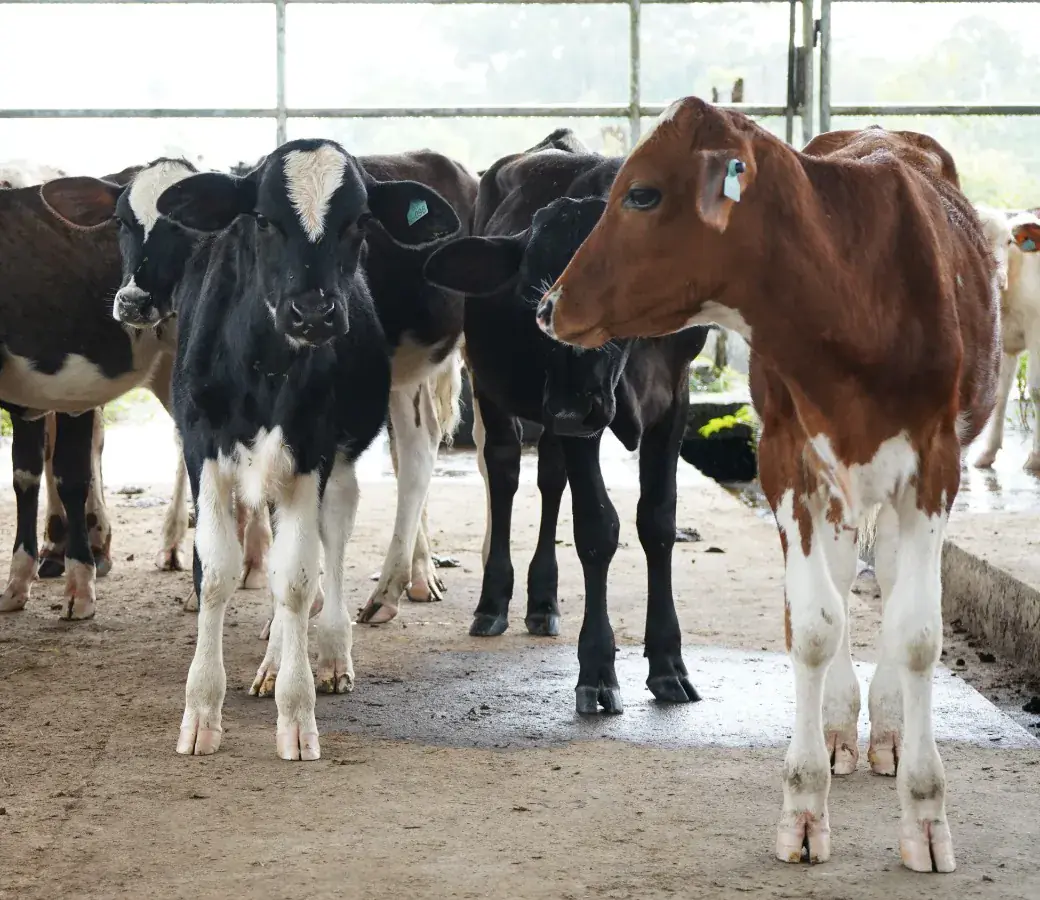
The census counted 19,714 cattle. Two districts hold almost two-thirds of them: Wanica with 6,276 head and Commewijne with 6,142.
The two leaders get there in opposite ways. Commewijne averages 58 cattle per holding against Wanica's 9: a hundred large herds against seven hundred small ones.
Herd size also differs by the sex of the manager. Holdings with cattle managed by men average 18 head, compared with 5 for women-managed holdings, and this gap in gender is present in every district.
Breeding is dominated by crosses. Cross-bred cattle are reported on 58.0% of cattle observations, pure-bred on 30.6% and Criollo on 11.4% — the last concentrated in Sipaliwini and Nickerie.
Semi-intensive systems are the most common. Semi-intensive systems account for 42.6% of reported systems, extensive for 35.4% and intensive for 22.0%.
The national herd contains more female cattle. Of 19,714 cattle, 13,636 are cows and heifers — just over two in three animals.
Sheep, goats and pigs
Share of holdings with sheep and with goats
- Goats
- Sheep
Sheep and goats are coastal animals. Coronie leads on sheep with a proportion rate of 22.2%, and neither animal is reported at all in Marowijne, Brokopondo or Sipaliwini.
The order flips in the capital. Paramaribo is the one district where goats (4.8%) outrank sheep (1.2%), the small-stock pattern of a peri-urban district.
Flocks are small and sized very differently by district. Commewijne averages 20 sheep per holding against Paramaribo's 1, on a national average of 12.
Pig farming is the most concentrated activity in the chapter. Six holdings in Saramacca hold 8,431 of the country's 11,056 pigs — more than three-quarters of the national herd.
That herd is a young one. Piglets make up 5,466 of the 11,056 pigs, with fatteners and breeding swine accounting for most of the rest.
Poultry
Types of poultry as a share of reported observations
Poultry includes various types of birds. Broilers are the most widespread, on 30.4% of reported poultry observations, and they are the commercial end of the sector.
Behind the broilers sits a household flock. Backyard chickens (23.5%) and Muscovite ducks (23.3%) are kept almost as widely, but in yards rather than sheds.
The four most common types of poultry, ranked by number, are: 598,062 broilers, 199,109 layers, 24,473 backyard chickens, and 38,491 muscovite ducks.
Broiler production is concentrated in just a few districts. Wanica alone has 345,018 of the 598,062 broilers, followed by Saramacca with 135,985.
The two leading districts get there in opposite ways. Wanica's 345,018 broilers sit on 594 holdings averaging 581 birds, Saramacca's 135,985 on 79 holdings averaging 1,721. Flocks are small almost everywhere else: below the national average of 426 in eight districts, and under 50 birds in four of them.
Most poultry is housed. Intensive systems account for 78.9% of reported poultry systems, open yards for 16.2% and battery cages for 4.9%.
The interior keeps poultry differently. In Sipaliwini open yards are the majority system at 54.6%, followed by Brokopondo at 54.0%.
Poultry is also where women manage most. Women manage 61% of poultry holdings in Brokopondo and 50% in Sipaliwini, against 11% in Nickerie and 28% nationally.
Grazing and grassland
Share of holdings grazing animals on the holding
Only 971 holdings, 6.7%, graze animals on the holding. Coronie has the highest proportion rate at 25.6%, Wanica the largest number at 563, and Brokopondo reports none.
Where grazing happens, it happens on very little land. Three-quarters of holdings with grazing areas use less than two hectares, and 438 of them less than half a hectare.
It is, however, a year-round practice. 617 of the 735 holdings with grazing cattle graze them for nine to twelve months of the year.
Poor spontaneous grassland is most common. Of 1,132 grassland parcels, 636 are poor spontaneous grassland, 365 improved spontaneous and only 133 cultivated.
And it is concentrated in one district. Wanica has 689 of the 1,132 grassland parcels, Commewijne 172, and Brokopondo none.
Thematic report
Gender, livestock and crops in one report: who manages the holdings, which animals they keep, and which crops they grow.