
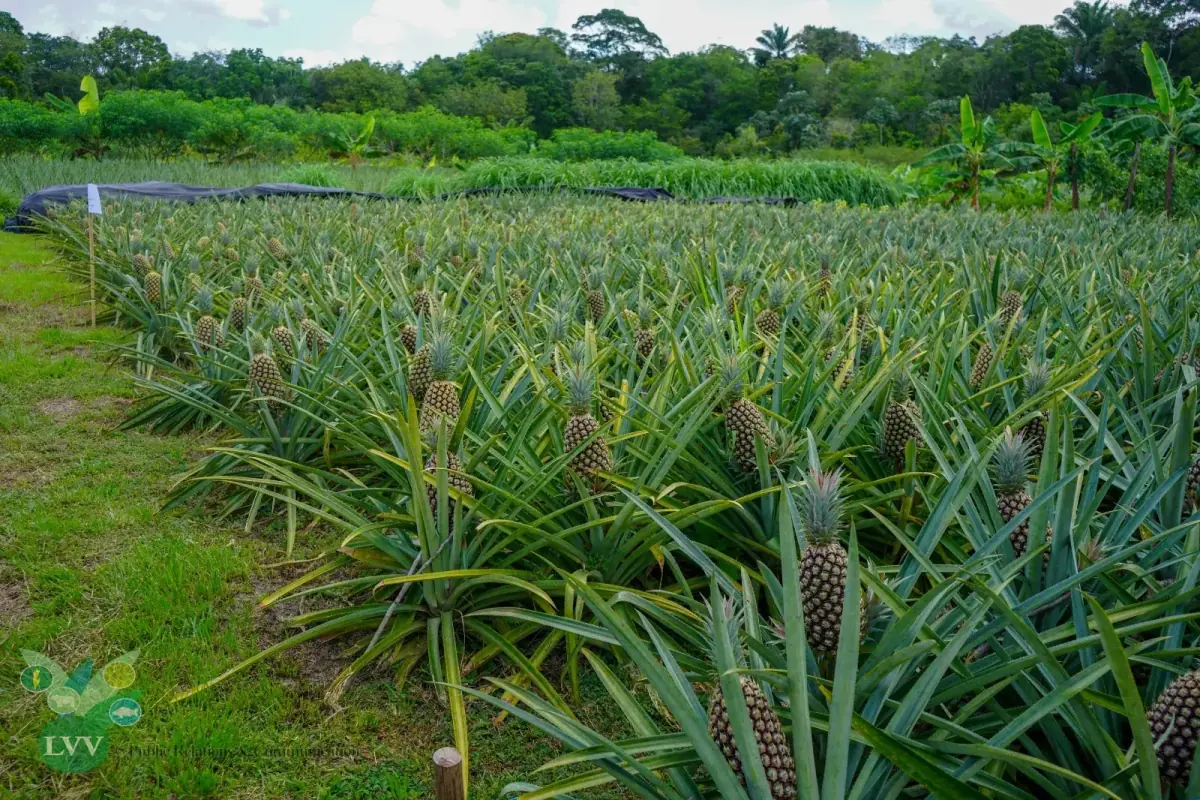
Annual crops
Holdings with at least one plot of annual and of (semi-)permanent crops
Suriname's agriculture is grown on short cycles. Of the 14,409 agricultural holdings, 75.6% work at least one plot of annual crops, against 45.5% with a plot of (semi-)permanent crops.
And two crops carry almost everything: sweet cassava is grown on 5,178 holdings and bitter cassava on 5,154 — more than a third of all holdings each.
The national crop, rice, comes third: 3,871 holdings grow rice, 26.9% of all holdings — one in four, not the majority its reputation suggests.
Annual cropping is near-universal in the interior: 97.4% of holdings in Sipaliwini grow annual crops, and 90.4% in Brokopondo.
One district has one majority crop: rice is grown on 97.0% of all holdings in Nickerie — and on every single male-managed holding in the district.
Along the coast the leading annual crop is not a staple but a cash vegetable: chili is the top annual crop in Commewijne, Paramaribo, Saramacca and Wanica, on up to a quarter of their holdings.
Men and women grow different annual crops. 55.3% of female-managed holdings grow bitter cassava, against 22.9% of male-managed ones — and the same gap runs through sweet cassava, taro and Indian yam.
Only one crop in that list leans the other way: rice is grown on 27.3% of male-managed holdings against 25.7% of female-managed ones — nearly level in participation, but first for men and fifth for women.
(Semi-)permanent crops
Ten most common (semi-)permanent crops by number of holdings
Among crops that are not replanted after every harvest, one dominates outright: plantain is grown on 4,555 holdings, 31.6% of the country — three times more common than the next crop.
Behind it is a short list of fruit trees: mango on 10.0% of holdings, coconut on 9.4% and banana on 8.4%. Everything else stays under 6%.
The districts differ clearly in their crop patterns: in Nickerie, 79.3% of holdings grow annual crops, while only 11.2% grow (semi-)permanent crops. In Coronie — with 90 holdings — the pattern is reversed: 27.8% compared with 51.1%.
Plantain is the one crop that is everywhere: it is the leading (semi-)permanent crop in eight of the ten districts, reaching 45.6% of holdings in Saramacca and 44.2% in Sipaliwini.
And it is a crop that is predominantly grown by women: nationally, 39.1% of female-managed holdings grow bananas, compared with 26.6% of male-managed holdings; in Brokopondo, this gap widens further, to 46% versus 25%.
Fertilizers
Holdings applying fertilizer and producing compost
Most holdings manage their soil with nothing bought and nothing made: 24.0% applied chemical fertilizer, 17.7% organic fertilizer and just 3.2% produced compost.
Organic fertilizer is a peri-urban practice: 43.3% of holdings in Paramaribo apply it, and 42.4% in Saramacca.
In the interior it is absent: 3 holdings in Brokopondo and 54 in Sipaliwini apply organic fertilizer — 0.3% and 1.3% of their holdings.
Where organic fertilizer is used, manure is by far the dominant source: manure accounts for 77.9% of all reported organic-fertilizer applications and plant material for 19.5%.
Chemical fertilizer maps the commercial districts almost exactly: 74.1% of holdings in Saramacca and 71.7% in Nickerie apply it, against 0.3% in Brokopondo.
The use of chemical fertilizer is limited to a few types: NPK and urea together are 83.0% of all reported chemical-fertilizer applications.
In the rice-growing district of Nickerie, the pattern is different: urea is the most widely used fertilizer at 38.4%, followed by superphosphate at 27.4% — both more than twice their national shares.
Almost nobody produces fertilizer on the holding: 456 holdings produced compost, 3.2% of the country, and a third of them are in Paramaribo.
Pesticide
Holdings applying pesticide by district
Crop protection follows the same coastal trend as chemical fertilizers: 75.4% of holdings in Saramacca and 74.0% in Nickerie applied pesticide, against a national 28.9%.
In the interior, pesticide is effectively unknown: 3 holdings in Brokopondo and 55 in Sipaliwini applied any — and in Marowijne, the interior's second-largest crop district, only a quarter did.
What is applied is conventional and aimed at two problems: insecticides and herbicides are 78.1% of all reported pesticide applications, fungicides another 16.0%.
Alternatives barely register: purchased and home-made organic pesticides together are 2.4% of applications — 197 of 8,159.
Irrigation and flooding
Holdings applying irrigation by district
Suriname’s agriculture is largely dependent on rainfall. Only 16.6% of holdings irrigate — but in Nickerie 60.6% do, and around a third in Saramacca and Commewijne.
Where most of the holdings are, there is almost no irrigation at all: under 1% of holdings in Marowijne, Sipaliwini and Brokopondo apply any, though they hold half the country's holdings between them.
Irrigation serves crops, not pasture: annual crops and rice together are 84.2% of all irrigated uses, pastures and meadows 0.3%.
How the water is applied is still largely manual: manual watering is 26.8% of reported irrigation methods and flooding 25.0%, while drip reaches only 6.0%.
The water itself comes from the holding barely tap water: surface water is 44.0% of all reported water sources, rising to 81.1% in Nickerie.
Flooding is also a problem: 1,040 holdings were flooded in 2024, and for almost one in four of them it happened three times or more. Paramaribo was the hardest hit, with 23.3% of its holdings flooded.
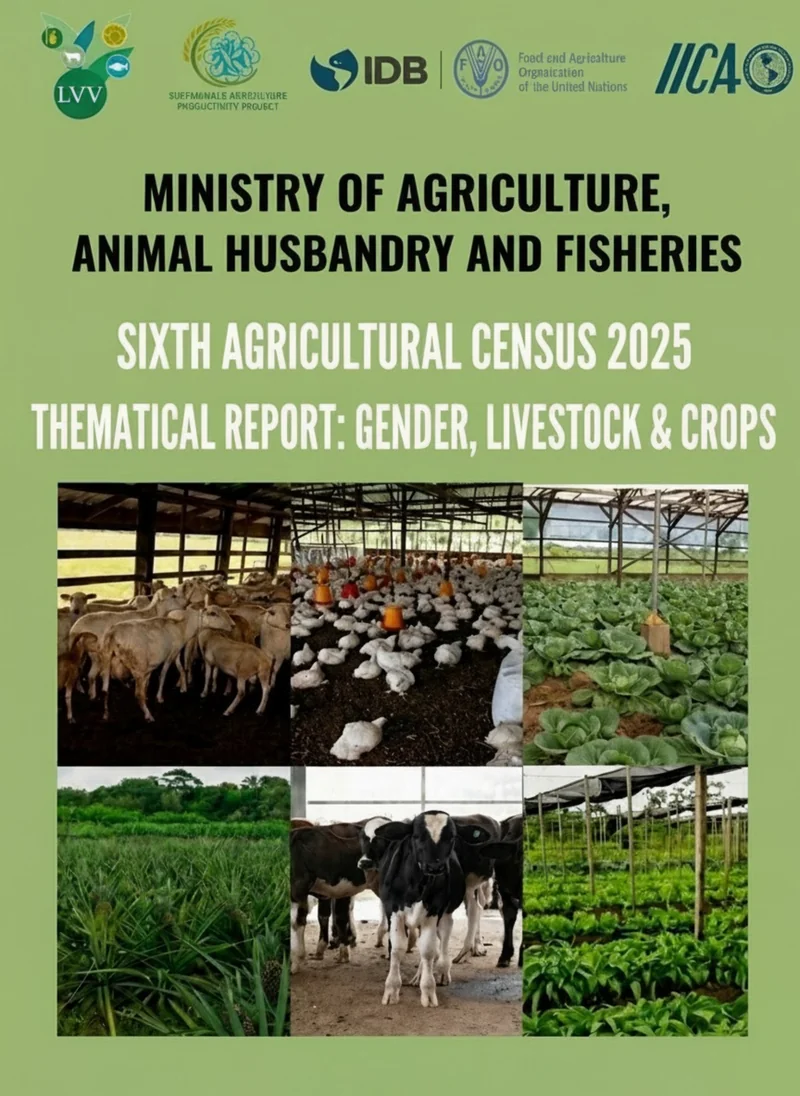
Thematic report
Gender, livestock and crops in one report: who manages the holdings, which animals they keep, and which crops they grow.