
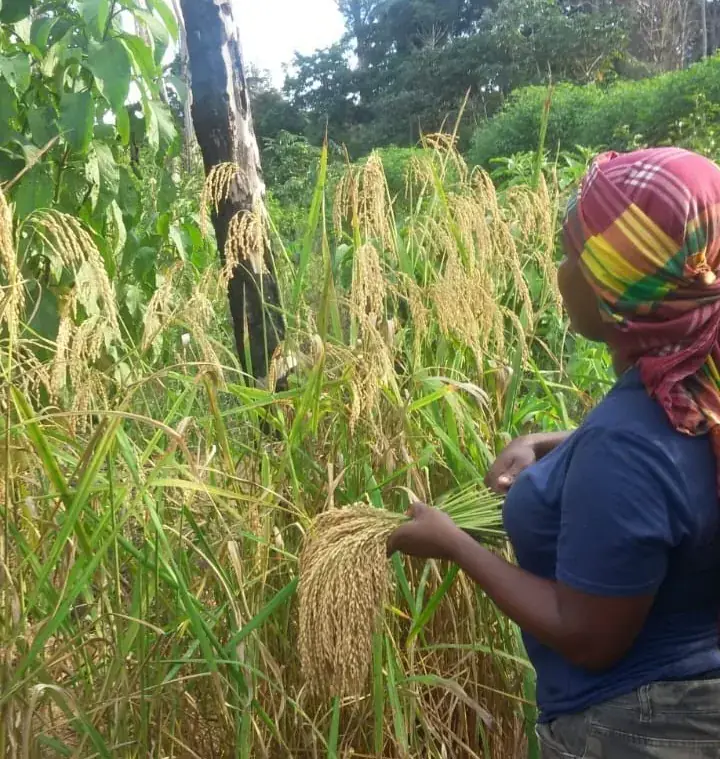
Who manages the agricultural holdings
agricultural holdings with a female main holder
Suriname’s agricultural sector is often associated with men operating agricultural machinery in rice fields. The Sixth Agricultural Census counted 14,409 agricultural holdings — and 5,692 of them have a woman as main holder.
That is 40% of all agricultural holdings in the country, up from 35% at the previous census in 2008.
While the national figure is 60% men and 40% women, districts differ widely from that average.
At one end, in the interior district of Brokopondo, 77% of holdings are managed by women — more than three female main holders for every male one.
At the other end, the rice district: in Nickerie just 8% of holdings are managed by women — about twelve male main holders for every female one.
Women's presence is strongest where the holding is run by an individual: 40% of single-holder holdings, but only 18% of partnerships and companies.
Only 3.9% of holdings have a main holder in any agricultural organisation, and that small group is almost entirely male: of the 556 member holdings, just 79 have a female main holder — 1 in every 7.
The gap is widest in membership of water boards: women hold 3% of waterboard memberships, concentrated in Nickerie.
One district breaks the pattern completely: in Marowijne, women make up 54% of organisation members — indicating that these differences are not the same everywhere.
Who the female main holders are
Share of female main holders by age group
While Suriname's main holders are generally ageing, women are most prominent in the 25–54 age group — 43% of main holders there, against 34% among those aged 55 and over.
Formal schooling divides the sector sharply: women are 59% of main holders with no schooling at all, but only 15% of those with a university degree.
Training in agriculture itself barely exists for anyone — 95.5% of main holders learned agriculture informally — and the little there is goes to men: of the 648 holdings whose main holder has any agricultural training, only 120 are female-managed.
The share of women as main holders is highest in holdings with one household member. Managing a holding alone, with the least schooling and no formal training, is therefore a disproportionately female situation — and the sharpest target for support.
Suriname's gender differences follows its cultural geography: Maroon and Afro-Surinamese holdings are majority female-managed (60% and 55%), Hindustani and Javanese holdings 86% male-managed.
Land and area
Share of holdings and agricultural area managed by women
The number of holdings tells a different story from the distribution of agricultural area. Women manage 40% of holdings but only 10% of the agricultural land.
On average, a woman manages 0.91 hectares against 5.13 for a man — a holding roughly five times smaller.
The gap is not everywhere: in Marowijne and Brokopondo men and women manage virtually identical areas (1.45 vs 1.36 ha; 0.40 vs 0.37 ha).
It is the commercial coast that pulls the country apart: in Coronie the average male holding is 21 times the female one, and in Commewijne 15 times.
Formal land rights lag even further behind management: women hold 18% of titled parcels, against 40% of the agricultural holdings.
One cultivation system runs on different rules: 42% of all holdings work at least one plot under shifting cultivation, and women manage 63% of them — nearly all in Sipaliwini, Brokopondo and Marowijne. At 3,786 holdings, shifting cultivation is the largest single form of female agricultural activity in the country, and the least visible in statistics and support programmes.
Assets, money and advice
Share of female main holders among holdings using each machinery group
Mechanisation follows the land: of the holdings using irrigation and drainage equipment, only 4% are female-managed, and 5% of those using harvesting machinery.
One group clearly stands out: 66% of the holdings using processing equipment are female-managed — creating added value after harvest. Differences can also be seen in the predominantly male-managed land-tillage activities: 58% of the holdings using a chainsaw are female-managed. The chainsaw is the only land-clearing tool that is relatively inexpensive and easy to carry by hand. By comparison, only 4% of holdings using a tractor are female-managed.
Livestock infrastructure is rare and mostly male managed: only 17.5% of all holdings have any animal shelter, and women are below their 40% in every single type — only 13% of cattle shelters and 27% of poultry, the closest they come.
Agricultural support reaches almost nobody: 1.9% of all holdings received financial support — 280 holdings in the whole country, 81% of them in Nickerie. And of those, just 10 went to female-managed holdings. Four percent, where women manage 40% of the holdings.
In Sipaliwini, where women manage 62% of holdings, none of the 16 supported holdings was female-managed.
Agricultural extension services also have limited reach: only 5.9% of holdings received extension services — and the share was 60% higher among male-managed holdings than among female-managed ones.
Two districts show that things can be different: in Sipaliwini, 58%, and in Marowijne, 52%, of holdings that received agricultural extension services are female-managed — while in Brokopondo and Coronie, no holdings receiving agricultural extension services were recorded at all.
Purpose and sale
Share of female main holders by share of production sold
While 62.5% of holdings sell more than half of what they produce, women thin out as the market share rises: they are 54% of holdings selling a tenth to a half of their output, and 29% of those selling almost everything.
The same pattern appears in what is sold: women account for 45% of annual-crop sellers but only 27% of permanent-crop sellers — crops such as orchards that takes years and secure land.
In animal-product sales, poultry is where women come closest: they are 31% of broiler sellers and 26% of egg sellers, while in cattle and dairy they barely appear at all: 96% of cattle sellers and 95% of milk sellers are men.
And once again the interior reverses everything: in Brokopondo women are 76% of the holdings selling crops, and in Sipaliwini 64%.
Thematic report
Gender, livestock and crops in one report: who manages the holdings, which animals they keep, and which crops they grow.